
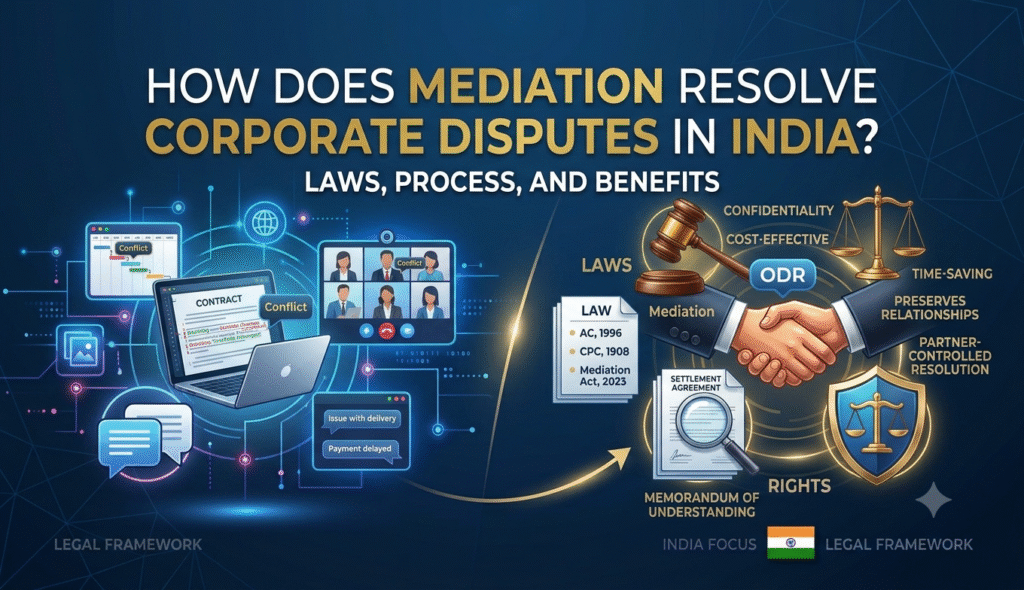
Mediation helps businesses resolve corporate and commercial disputes through structured negotiations facilitated by a neutral third party. In India, mediation is recognised under the legal framework governing commercial contracts and alternative dispute resolution (ADR). It allows parties to explore mutually acceptable settlements without requiring a court or arbitrator to decide every disagreement.
Corporate disputes involving contract breaches, delayed payments, partnership disagreements and business obligations can often be addressed through mediation. However, certain commercial disputes require pre-institution mediation before litigation, making it important for businesses to understand the applicable legal framework.
What Is Corporate Dispute Resolution Through Mediation?
Corporate dispute resolution refers to the legal processes used to resolve disagreements between companies, business partners, shareholders and other commercial parties.
Mediation is a voluntary, non-adjudicatory process in which an independent mediator helps parties negotiate a settlement. Unlike arbitration, the mediator does not impose a binding decision.
For example, if a supplier fails to deliver goods within the agreed contractual period, both companies may disagree over compensation. Through commercial mediation, they can negotiate revised delivery schedules, payment adjustments or other settlement terms.
This approach is particularly useful when businesses want to resolve contractual disputes while maintaining ongoing commercial relationships.
Statutory Framework for Mediation in Commercial Disputes
India’s legal framework recognises mediation through several statutes governing civil proceedings, commercial disputes and alternative dispute resolution.
Section 89 of the Code of Civil Procedure, 1908
Section 89 of the CPC provides for court-referred alternative dispute resolution where the circumstances indicate the possibility of settlement.
Courts may refer suitable matters to mediation, arbitration, conciliation or judicial settlement under the applicable framework.
This provision is relevant to commercial contract disputes where negotiated settlement may be more suitable than prolonged litigation.
Section 12A of the Commercial Courts Act, 2015
Section 12A requires pre-institution mediation for qualifying commercial suits that do not contemplate urgent interim relief.
The objective is to encourage businesses to explore settlement before initiating litigation.
The statutory process provides a period of 120 days for mediation, extendable by another 60 days with the parties’ consent.
However, the requirement does not apply in the same way where a commercial suit genuinely contemplates urgent interim relief.
Mediation Act, 2023
The Mediation Act, 2023 establishes a broader statutory framework for mediation in India.
Its provisions address:
- Mediation agreements and procedures.
- Institutional mediation and mediator registration.
- Confidentiality of mediation proceedings.
- Online mediation.
- Enforcement and challenges to mediated settlement agreements.
The Act follows phased commencement. The initial notification of 9 October 2023 brought specified administrative and institutional provisions into force, while major procedural and enforcement provisions were not included in that notification.
Therefore, the enforceability of a particular settlement must be assessed under the law currently in force and the process used.

When Is Pre-Litigation Mediation Mandatory in India?
Under Section 12A of the Commercial Courts Act, qualifying commercial suits generally require pre-institution mediation when urgent interim relief is not contemplated.
In Patil Automation Pvt. Ltd. v. Rakheja Engineers Pvt. Ltd. (2022), the Supreme Court confirmed the mandatory nature of Section 12A. Failure to comply can result in rejection of the plaint.
The Supreme Court further clarified in Yamini Manohar v. T.K.D. Keerthi (2023) that merely requesting urgent interim relief cannot automatically justify bypassing mediation.
Courts must examine whether the need for urgent relief genuinely arises from the circumstances.
For businesses, this means that the appropriate dispute resolution strategy should be considered before filing a commercial suit.
Role of Mediation Clauses in Commercial Contracts
A mediation clause is a contractual provision requiring or encouraging parties to attempt settlement through mediation when disputes arise.
Businesses may include mediation clauses in supply agreements, service contracts, joint venture agreements and other commercial arrangements.
A well-drafted mediation clause should clearly specify:
- The disputes covered by mediation.
- The procedure for appointing a mediator.
- Applicable institutional rules, if any.
- Time limits for attempting settlement.
- Confidentiality requirements.
- The next legal remedy if mediation fails.
For example, a contract may require parties to attempt mediation for 45 days before referring unresolved disputes to arbitration.
Such arrangements create a structured dispute resolution process and reduce uncertainty when disagreements arise.
Mediation vs Arbitration in Commercial Disputes
Although mediation and arbitration are recognised methods of alternative dispute resolution, they differ in their procedures and outcomes.
| Factor | Mediation | Arbitration |
|---|---|---|
| Role of neutral party | Facilitates negotiations | Decides the dispute |
| Outcome | Mutually agreed settlement | Arbitral award |
| Decision-making | Controlled by parties | Determined by arbitrator |
| Procedure | Generally flexible | More formal |
| Business relationships | Encourages negotiated solutions | Focuses on adjudication |
| Enforcement | Depends on applicable settlement framework | Governed by arbitration law |
Mediation may be appropriate where parties are willing to negotiate. Arbitration is generally more suitable when businesses require a binding determination of disputed rights.
Both mechanisms can operate together through multi-tier dispute resolution clauses.
How Does the Corporate Mediation Process Work?
Commercial mediation generally follows a structured procedure.
1. Initiating Mediation
One party proposes mediation under the commercial contract or applicable statutory procedure.
2. Appointing a Mediator
Parties select a neutral mediator independently or through an appropriate mediation institution.
3. Identifying the Dispute
Both parties explain their concerns, contractual obligations and desired outcomes.
4. Negotiating Settlement Terms
The mediator facilitates discussions and helps parties explore commercially acceptable solutions.
5. Recording the Settlement
If negotiations succeed, the parties document their agreed obligations in a written settlement agreement.
Where mediation fails, businesses may proceed through arbitration or litigation, subject to applicable legal requirements.
Enforceability of Mediated Settlement Agreements
The enforceability of a mediated settlement depends on the applicable statutory framework.
Section 12A of the Commercial Courts Act provides a recognised mechanism for settlements reached through pre-institution mediation.
The Mediation Act, 2023 also contains provisions under Sections 27 and 28 concerning enforcement and challenges to mediated settlement agreements. However, their operation depends on the commencement of those provisions.
Businesses should ensure that settlement agreements clearly record payment obligations, performance requirements, deadlines and consequences of non-compliance.
Proper documentation helps avoid further disputes over the meaning or implementation of agreed terms.
Judicial Pronouncements on Corporate Mediation
Indian courts have consistently recognised the importance of alternative dispute resolution in appropriate commercial matters.
In Afcons Infrastructure Ltd. v. Cherian Varkey Construction Co. (2010), the Supreme Court clarified the application of Section 89 CPC and the selection of suitable disputes for ADR.
In Patil Automation (2022), the Court reinforced mandatory pre-institution mediation under Section 12A.
These judgments demonstrate the judiciary’s emphasis on settlement opportunities while preserving the legal requirements governing commercial proceedings.
Benefits and Challenges of Corporate Mediation
Mediation offers several practical advantages for businesses:
- Flexible settlement arrangements.
- Greater control over negotiated outcomes.
- Potential reduction in litigation expenses.
- Opportunities to preserve commercial relationships.
- Confidential discussions, subject to applicable legal protections.
However, mediation also has limitations. A settlement depends on the willingness of parties to negotiate, and unsuccessful mediation may require further proceedings.
Complex disputes involving fraud allegations, urgent injunctions or third-party rights may require different legal remedies.
Best Practices for Businesses
Companies should incorporate clear dispute resolution clauses into commercial contracts and assess mediation before initiating litigation.
They should also maintain contractual records, document communications and appoint representatives authorised to negotiate settlement terms.
Early legal assessment helps businesses determine whether mediation, arbitration or court proceedings are appropriate.
Conclusion
Mediation has become an important mechanism for corporate dispute resolution in India. The Commercial Courts Act, CPC and developing Mediation Act framework recognise its role in resolving commercial disagreements.
For businesses, mediation provides an opportunity to negotiate settlements, manage contractual conflicts and preserve commercial relationships.
However, successful dispute resolution requires carefully drafted mediation clauses, appropriate legal procedures and clearly documented settlements.
For assistance with commercial contracts, mediation clauses or corporate dispute resolution, contact Arohana Legal to discuss your legal requirements.
Frequently Asked Questions
Mediation is a structured negotiation process in which a neutral mediator assists businesses in reaching a mutually acceptable settlement without imposing a decision.
Section 12A of the Commercial Courts Act requires pre-institution mediation for qualifying commercial suits that do not contemplate urgent interim relief.
Mediation may help resolve contract breaches, payment disagreements, supplier disputes, partnership conflicts and other legally suitable commercial matters.
Parties may pursue arbitration or litigation, depending on their contractual arrangements and applicable legal requirements.
A settlement can create binding obligations. Its statutory status and enforcement procedure depend on the applicable law and the mediation process followed.
Under Section 12A, the statutory process provides 120 days, extendable by another 60 days with the parties' consent. Private mediation timelines may differ.
Yes. Commercial contracts may provide for mediation before arbitration through a multi-tier dispute resolution clause.