
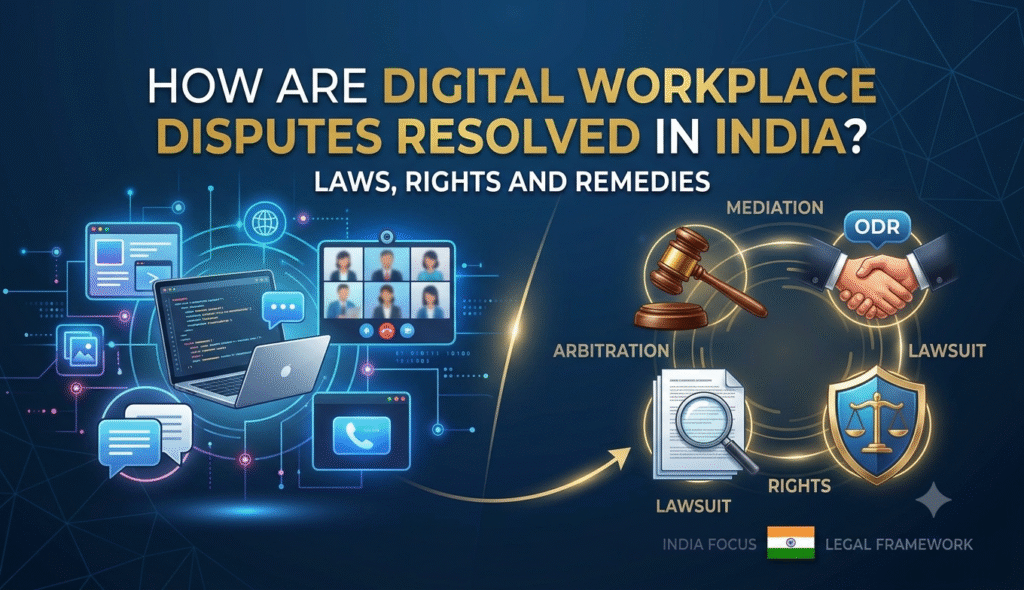
Digital workplace disputes in India can be resolved through internal grievance procedures, labour authorities, industrial tribunals, mediation or arbitration, depending on the nature of the conflict. Employees working remotely or in hybrid arrangements remain protected by applicable labour laws, employment contracts and workplace regulations.
As digital workplaces continue to expand, disputes involving unpaid wages, wrongful termination, online harassment, employee monitoring and performance expectations require clear legal remedies.
What Is Dispute Resolution in Digital Workplaces?
Digital workplaces are virtual work environments where employees use connected devices, cloud-based tools and online communication platforms to perform their duties remotely.
Dispute resolution in digital workplaces refers to the legal and procedural mechanisms used to address conflicts between employers and employees working through these environments.
For example, an employee receiving a termination notice through email may question whether the employer complied with contractual notice requirements and applicable employment laws.
Similarly, inappropriate messages during virtual meetings may raise workplace harassment concerns even when employees are working from home.
Applicable Indian Legal Framework for Digital Workplaces
India’s existing labour and contractual laws continue to apply to remote and hybrid employment.
The four Labour Codes became effective on 21 November 2025, consolidating 29 central labour laws.
These include:
- Code on Wages, 2019: Regulates minimum wages, payment timelines and permissible deductions.
- Industrial Relations Code, 2020: Governs industrial disputes, retrenchment and related employment matters.
- Code on Social Security, 2020: Addresses applicable social security benefits.
- Occupational Safety, Health and Working Conditions Code, 2020: Establishes workplace safety and employment standards for covered establishments.
The Indian Contract Act, 1872 also governs contractual employment obligations.
Additionally, the POSH Act, 2013 provides protection against workplace sexual harassment, while the Information Technology Act, 2000 and developing DPDP framework address relevant digital information and privacy concerns.
The DPDP Act, 2023 follows phased implementation, with several substantive requirements scheduled to commence in May 2027.

Common Disputes in Digital and Remote Workplaces
1. Online Harassment and Workplace Misconduct
Harassment may occur through inappropriate messages, unwanted video calls, offensive remarks during meetings or online stalking.
The POSH Act can extend to sexual harassment occurring through work-related digital communication.
Employers must maintain appropriate complaint mechanisms and ensure employees understand their reporting options.
2. Wage and Allowance Disputes
Remote employees may experience delayed salaries, unauthorized deductions, unpaid overtime or disagreements concerning employment allowances.
Applicable wage legislation continues to protect eligible employees regardless of their working location.
For example, an employer cannot automatically disregard contractual salary obligations simply because an employee works from home.
3. Wrongful Termination and Dismissal
Employees may receive termination notices through email or virtual meetings without adequate explanation.
However, digital communication does not remove applicable notice, compensation or procedural requirements.
Whether termination is unlawful depends on the employee’s classification, contractual provisions and relevant labour laws.
4. Employee Privacy and Data Protection
Employee monitoring software, webcam tracking and workplace communication records can raise privacy concerns.
Employers should establish transparent policies explaining monitoring practices, data collection, storage and access.
The phased implementation of the DPDP framework makes reviewing employee data protection practices particularly important.
5. Performance and Productivity Conflicts
Remote work may create disagreements concerning attendance, productivity targets, working hours and deliverables.
Clear employment contracts, documented performance expectations and regular communication can help prevent these conflicts.
How Can Employees Resolve Digital Workplace Disputes?
The appropriate dispute resolution mechanism depends on the complaint and the legal rights involved.
| Dispute | Possible Resolution Mechanism |
|---|---|
| Unpaid wages or unlawful deductions | Internal grievance procedure or designated wage authority |
| Wrongful termination | Conciliation or industrial adjudication, where applicable |
| Online sexual harassment | Internal Committee or Local Committee under POSH |
| Contractual disagreements | Negotiation, mediation, arbitration or civil proceedings |
| Employee data privacy concerns | Internal complaint process and applicable legal remedies |
| Performance disputes | HR grievance procedure or contractual dispute resolution |
Labour Authorities and Industrial Tribunals
Employees covered by applicable industrial dispute provisions may approach labour authorities for conciliation or adjudication.
The Industrial Relations Code, 2020 provides the statutory framework for eligible industrial disputes.
Online Dispute Resolution and the SAMADHAN Portal
The government’s SAMADHAN portal allows eligible workers and other stakeholders to submit employment-related claims electronically.
The SAMADHAN 2.0 system supports case filing under the Labour Codes and provides an online route for accessing applicable grievance mechanisms.
This is particularly useful for remote employees who cannot easily visit labour offices.
Arbitration and Mediation
Arbitration may resolve contractual disputes where a valid arbitration agreement exists and the subject matter is legally arbitrable.
Mediation provides another option for parties seeking an agreed settlement.
The Mediation Act, 2023 contains provisions concerning online mediation, including Section 30. Their application depends on the relevant commencement notifications.
Online dispute resolution can therefore support workplace settlements, although statutory labour remedies cannot automatically be replaced by private agreements.
What Does Indian Case Law Say About Employment Disputes?
In Dushyant Janbandhu v. Hyundai Autoever India Pvt. Ltd., 2024 INSC 966, the Supreme Court examined whether disputes concerning unpaid wages and termination could be referred to arbitration.
The Court held that the statutory disputes already raised before the relevant authorities were non-arbitrable in the circumstances of the case.
The judgment highlights an important distinction: an employment contract containing an arbitration clause does not necessarily prevent employees from pursuing statutory remedies.

Employer Obligations in Remote Work Context
Employers must comply with applicable employment requirements even when employees work outside traditional office premises.
Important obligations include:
- Paying agreed wages and statutory benefits.
- Maintaining employment and attendance records.
- Addressing online workplace harassment.
- Protecting employee information.
- Defining working hours and performance expectations.
- Providing appropriate grievance redressal mechanisms.
Employers should also clarify equipment reimbursement, cybersecurity responsibilities and workplace monitoring through written policies.
Gaps in Current Legal Provisions
Although India’s labour framework has undergone significant reform, remote employment continues to raise questions that existing legislation does not address comprehensively.
These include employer responsibility for home-office safety, reimbursement of remote working expenses, employee surveillance and working hours across different locations.
The absence of a uniform remote work framework makes clear contractual arrangements particularly important.
Reform Suggestions and Best Practices
Employers can reduce digital workplace disputes by adopting written remote work policies and regularly reviewing employment contracts.
Policies should address working hours, employee monitoring, cybersecurity, performance evaluation, complaint procedures and expense reimbursement.
Employees should preserve relevant emails, salary records, employment documents and digital communications when a dispute arises.
Early grievance resolution and legally appropriate mediation can help prevent disagreements from escalating into formal proceedings.
Conclusion
The expansion of digital workplaces in India has introduced new legal challenges involving employee rights, workplace conduct, privacy and employment disputes.
The Labour Codes, POSH Act, contractual laws and developing data protection framework provide important legal protections. Judicial decisions also reinforce the role of statutory authorities in resolving employment disputes.
Employers and employees should maintain clear agreements, preserve relevant documentation and use appropriate legal mechanisms to resolve conflicts fairly.
For assistance with workplace disputes, employment compliance or legal remedies, contact Arohana Legal to discuss your requirements.
Frequently Asked Questions
Yes. Applicable labour protections continue to operate in remote employment. Specific rights depend on the employee's classification, employment terms and relevant legislation.
Yes. An employee may challenge termination where it violates applicable statutory protections or contractual requirements. The method of communication alone does not determine legality.
Eligible employees can use the SAMADHAN portal for supported employment claims. Other complaints may require an internal grievance process or designated legal authority.
Yes. Work-related sexual harassment through digital communication may fall within the POSH Act, depending on the circumstances.
Monitoring is not automatically prohibited. Employers must comply with applicable contractual, privacy and data protection requirements.
No. An arbitration clause cannot automatically override statutory labour remedies. The nature of the dispute determines whether arbitration is legally available.
Yes, parties may use appropriate online mediation arrangements where legally permitted. The applicable procedure and enforceability depend on the relevant legal framework.